
Повнораціонне харчування нового покоління – сухі корми від ТМ AnimAll!
..

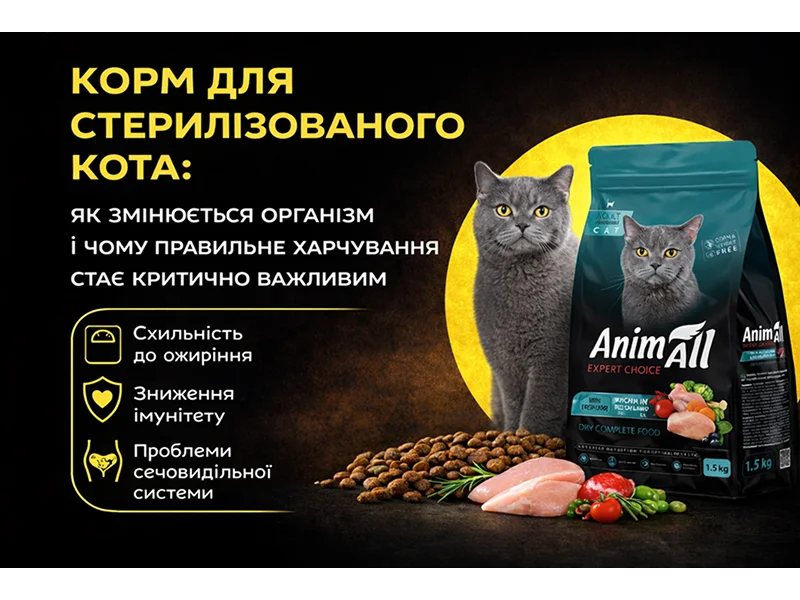
Spaying and neutering cats today are considered not only as a way to control reproduction, but also as an important element of responsible pet care. These procedures directly affect lifespan, behavior, and the risk of developing serious diseases. At the same time, they trigger complex physiological changes that require a revision of the diet. That is why the query "food for sterilized cat" is one of the key ones for owners after surgery.
From a medical point of view, sterilization (ovariohysterectomy) in female cats and castration (orchiectomy) in male cats reduce the risk of hormone-dependent pathologies and significantly affect overall health. In females, this primarily includes prevention of pyometra (purulent inflammation of the uterus) and mammary gland tumors; in males — reduced risk of prostate diseases and behavioral disorders.
After surgery, behavior also changes: aggression, territorial marking, nighttime activity, and stress levels decrease. In the long term, this creates a more stable and comfortable living environment for the animal.
The optimal age for sterilization is usually 5–7 months. During this period, the body adapts best to changes, but at the same time a new stage begins — metabolic restructuring, which is directly related to nutrition.
After the removal of the gonads, the levels of estrogens or testosterone decrease, which affects the hypothalamic-pituitary system. As a result, the regulation of appetite and energy metabolism changes.
Basal metabolic rate (BMR) decreases, meaning the amount of energy the body expends at rest. At the same time, appetite increases due to changes in leptin and ghrelin hormone levels. This means the cat starts eating more but expends less energy.
On average, after sterilization, caloric needs decrease by 20–30%. Without dietary changes, this almost inevitably leads to weight gain.
The most obvious consequence of improper nutrition is obesity. At the same time, adipose tissue in cats acts as an active endocrine organ, influencing metabolic and inflammatory processes, gradually disrupting the function of the entire body.
No less important is the issue of the urinary system. In sterilized cats, urine acidity often changes and water intake decreases, creating favorable conditions for the formation of crystals and stones. Struvites and calcium oxalates are especially dangerous.
Thus, a standard diet that was suitable before sterilization becomes a risk factor after surgery.
For the diet to match the new physiological conditions, it must be precisely balanced in key nutrients. It is important not just to reduce calories, but to ensure the correct ratio of proteins, fats, minerals, and functional additives.
Below are indicative values that meet the needs of sterilized cats:
| Parameter | Optimal level | Role in the body |
|---|---|---|
| Protein | 30–40% | Muscle support, metabolism |
| Fats | 10–15% | Energy control |
| Fiber | 3–7% | Satiety, digestion |
| Caloric content | 300–380 kcal/100 g | Weight control |
| Magnesium (Mg) | 0.06–0.1% | Struvite prevention |
| Phosphorus (P) | 0.7–1.0% | Metabolism |
| Calcium (Ca) | 0.8–1.2% | Skeletal system |
| Ca:P ratio | 1.1–1.3 : 1 | Mineral balance |
| Sodium (Na) | 0.2–0.4% | Fluid balance support |
| Omega-3 | 0.3–0.6% | Anti-inflammatory effect |
| Omega-6 | 2–4% | Skin and coat health |
| Taurine | 1000–1500 mg/kg | Heart, vision |
| Vitamin A | 10000–20000 IU/kg | Immunity |
| Vitamin D3 | 800–1500 IU/kg | Calcium metabolism |
| Vitamin E | 80–200 mg/kg | Antioxidant protection |
These parameters determine whether the food works as a preventive tool rather than just a source of calories.
Theoretical recommendations are valuable only when implemented in a specific product. That is why when choosing, it is important to analyze not only positioning but the actual composition of the food.
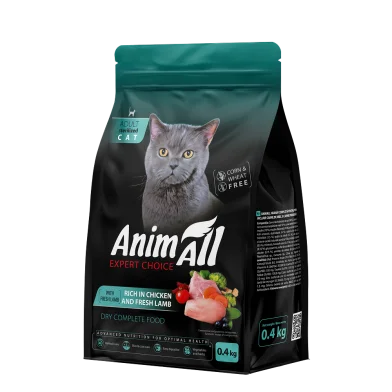
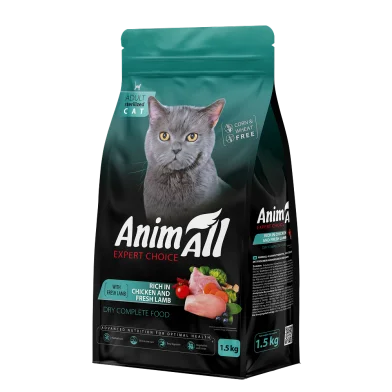
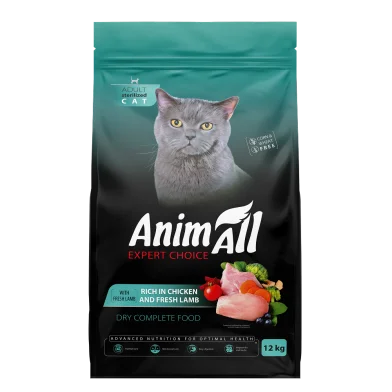
Complete dry food AnimAll for sterilized cats, with chicken and fresh lamb, is an example of a diet built according to these principles. Its formula is based on a combination of dehydrated chicken (28%) and fresh lamb (15%), providing high protein bioavailability and a complete amino acid profile.
The analytical composition — 37% protein and 13% fat — meets weight control requirements while maintaining muscle mass. This is especially important in conditions of reduced metabolism after sterilization.
The mineral balance of the food, including controlled levels of magnesium, phosphorus, and calcium, is complemented by functional components such as cranberries, which help support urinary tract health.
Additional ingredients, including salmon oil, brewer’s yeast, and plant extracts, support metabolism, immune response, and coat condition. A vitamin and mineral complex with taurine and bioavailable trace elements provides comprehensive support for the body.
Thus, this diet not only fits the category "food for sterilized cat", but implements it in practice — through precise nutrient balance and functional composition.
Sterilization changes a cat’s body at a deep level, affecting the hormonal system, metabolism, and behavior. Under these conditions, nutrition becomes a key factor that determines the animal’s future health.
That is why the right choice of food for sterilized cat is not a matter of brand, but a conscious decision based on physiology and scientific principles.
A balanced diet adapted to the body’s new needs allows not only avoiding typical problems but also ensuring a long, active, and healthy life for your pet.
We are always happy to help! If you have any questions, suggestions, or want to learn more about our services, feel free to reach out – we will be glad to assist you.
